
Watermelon and Muskmelon Cultivation Guide (Part 1): Plant Spacing, Yield and Crop Management

Watermelon and muskmelon are among the most popular summer fruit crops cultivated in India. Their strong market demand, relatively short growing period, and potential for good returns make them attractive options for commercial growers. However, successful melon cultivation is not simply about planting more seeds or applying more fertilisers. Crop productivity depends on the right balance of plant population, sunlight, soil moisture, temperature, nutrition, pollination and good-quality mulch film.
Many farmers focus on increasing the number of plants per acre, assuming that higher plant density automatically means higher production. In reality, overcrowding can restrict vine growth, reduce sunlight penetration, and affect fruit development. Similarly, even a healthy crop can experience reduced productivity when soil moisture fluctuates, weeds compete for nutrients, or pest pressure is not properly managed.
Understanding Watermelon and Muskmelon Crop Requirements
Watermelon and muskmelon belong to the Cucurbitaceae family and are warm-season crops. Both require suitable temperatures, good sunlight, well-drained soil, and proper water management for healthy development. Although their cultivation practices share many similarities, crop duration, vine growth, fruit size, and harvesting requirements vary according to the selected variety.
Crop Duration and Growing Conditions
| Parameter | Watermelon | Muskmelon |
| Botanical name | Citrullus lanatus | Cucumis melo |
| Typical crop duration | Approximately 80–110 days | Approximately 75–100 days |
| Preferred climate | Warm and sunny | Warm and sunny |
| Suitable soil | Well-drained sandy loam or loam | Well-drained sandy loam or loam |
| Indicative preferred soil pH | 6.0–7.5 | 6.0–7.5 |
| Important growth factors | Sunlight, moisture, nutrition, pollination | Sunlight, moisture, nutrition, pollination |
Crop duration and growing requirements vary according to the variety, region, season, and cultivation practices. Good drainage is particularly important because prolonged waterlogging can reduce root activity and encourage root-related diseases. Similarly, adequate sunlight is essential for photosynthesis, which directly influences plant growth and fruit development.
How Many Watermelon and Muskmelon Plants Should Be Maintained Per Acre?
One of the most important decisions in commercial melon cultivation is determining the correct plant population. For certain commercial cultivation systems using drip irrigation and mulch film, approximately 3,500–4,500 plants per acre may be considered as a planning range for watermelon and muskmelon.
However, this range is not suitable for every variety or cultivation system. Large-vined watermelon varieties may require wider spacing, while compact or smaller-fruited hybrids may tolerate higher densities. The final planting population should always follow the selected variety’s recommendations, growth habit, and field layout.
Why More Plants Do Not Always Mean More Production?
During the first few weeks after sowing, melon plants occupy relatively little space. Farmers may feel that the field has too much empty space and consider increasing the number of plants. However, after approximately 30–35 days, depending on growing conditions, the vines begin spreading rapidly. When too many plants are maintained in a limited area, neighbouring vines may overlap and create an excessively dense canopy.
This can lead to several problems.
- Reduced Sunlight Penetration
When the upper leaves overlap, they shade the lower leaves and reduce the amount of sunlight reaching different parts of the canopy. - Reduced Photosynthesis in Shaded Leaves
Photosynthesis is the process through which plants use sunlight to produce carbohydrates required for growth and fruit development.
Excessive shading can reduce photosynthetic activity in lower leaves, potentially affecting overall crop performance. - Greater Competition for Water and Nutrients
An excessively high plant population increases competition for the resources available in the root zone. - Poor Air Circulation
Dense vines can restrict airflow and create humid conditions favourable for certain crop diseases. - Uneven Fruit Development
Excessive competition may influence fruit size, uniformity, and marketable quality.
The objective should therefore be to maintain an optimum plant population, not simply the maximum number of plants.
How to Calculate Plant Population Per Acre
Plant population depends on both row-to-row spacing and plant-to-plant spacing. The approximate calculation is:
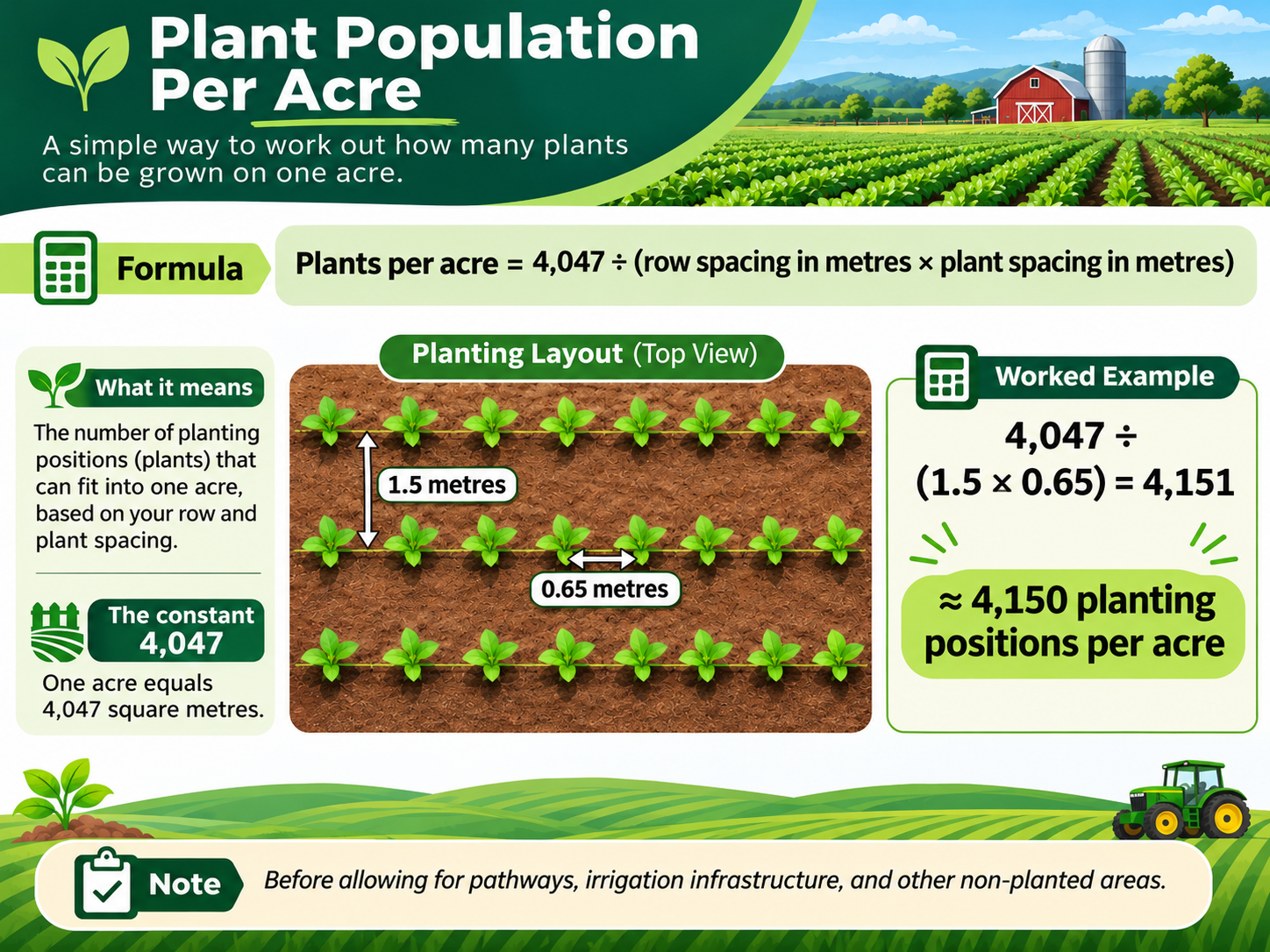
This calculation helps growers understand why both spacing measurements are important. Final spacing should be adjusted according to the variety and local agronomic recommendations.
What Is the Expected Yield of Watermelon and Muskmelon Per Acre?
Crop yield depends on several factors, including variety selection, soil conditions, plant population, nutrition, irrigation, pollination, pest management, and weather. When growers follow suitable crop-management practices and use appropriate high-yielding varieties, good commercial productivity is possible. Under favourable growing conditions, the following figures can be considered as indicative yield targets.
| Crop | Indicative Plant Population | Potential Production Per Acre |
| Watermelon | 3,500–4,500 plants | 22–25 tonnes |
| Muskmelon | 3,500–4,500 plants | 14–18 tonnes |
These are potential production targets under favourable management, not guaranteed or universal average yields. Actual results vary with variety, fruit size, plant spacing, pollination, climate, soil conditions, and crop-management practices.
What Determines Final Yield?
- Variety Selection: Choose varieties suited to the local climate, market demand, and desired fruit characteristics.
- Plant Population: Maintain appropriate spacing to support vine development and sunlight availability.
- Water Management: Avoid excessive moisture stress or waterlogging during important crop stages.
- Balanced Nutrition: Supply nutrients according to crop development and soil requirements.
- Pollination: Support effective pollination during flowering and fruit setting.
- Pest and Disease Management: Monitor the crop regularly to minimise avoidable losses.
- Fruit Quality Management: Maintain suitable growing conditions to improve fruit uniformity and marketable quality.
A productive crop depends on how effectively these factors work together.
Importance of Integrated Nutrient Management (INM) in Melon Cultivation
Watermelon and muskmelon require balanced nutrition throughout their growth cycle. Integrated Nutrient Management combines suitable organic inputs, inorganic fertilisers, soil testing, and crop-specific nutrition practices to support plant development and soil health.
Different crop stages have different nutritional requirements.
- Early Vegetative Growth
During establishment and early vine growth, the crop requires suitable nutrient availability for root development, leaf formation, and healthy plant growth. Nitrogen supports vegetative development, while phosphorus and other nutrients contribute to important plant functions. - Flowering and Fruit Setting
During flowering, balanced nutrition becomes important for supporting plant health and reproductive development. Excessive nitrogen application can encourage unnecessary vegetative growth in some conditions. Proper nutrient balance, rather than simply increasing fertiliser quantity, is essential. - Fruit Development
Potassium plays important roles in plant water regulation, carbohydrate movement, and fruit development. Calcium, magnesium, and micronutrients are also important for normal physiological functions. However, fertiliser recommendations should be based on soil testing, crop stage, irrigation-water quality, and variety requirements.
Why Root Health Matters
Healthy roots are essential for efficient nutrient absorption. Fine white feeder roots actively absorb water and dissolved nutrients from the soil. When the soil maintains suitable moisture, temperature, and aeration, root development and nutrient uptake are better supported. This is one reason why soil moisture management is such an important part of commercial melon cultivation.
Integrated Pest Management (IPM) for Watermelon and Muskmelon
Insect pests and diseases can affect both fruit quality and marketable yield. Common pests in melon cultivation include aphids, whiteflies, thrips, fruit flies, and certain leaf-feeding insects. Some insects can also transmit viral diseases, particularly during early plant growth.
Important IPM Practices
- Regularly inspect plants for early signs of pests and diseases.
- Use healthy seeds or seedlings from reliable sources.
- Maintain proper plant spacing and field sanitation.
- Remove weeds and manage alternate pest hosts.
- Use appropriate monitoring traps and preventive measures where recommended.
- Encourage beneficial insects and follow suitable biological-control practices.
- Apply crop-protection products only when required and according to approved recommendations.
Integrated Pest Management aims to reduce pest damage through a combination of preventive, cultural, biological, and appropriate chemical-control methods. Regular monitoring is especially important because problems identified early are generally easier to manage.
Irrigation Management: Why Consistent Soil Moisture Matters
Watermelon and muskmelon need adequate soil moisture for root growth, flowering, and fruit development. However, both excessive irrigation and moisture stress can affect crop performance. Drip irrigation is widely used in commercial melon cultivation because it delivers water near the root zone and allows more controlled irrigation management.
Benefits of Proper Drip Irrigation
- Delivers water near plant roots.
- Supports more consistent soil moisture.
- Reduces unnecessary water application.
- Allows fertigation where suitable.
- Helps limit excessive wetting of non-cropped areas.
Irrigation should be scheduled according to soil type, crop stage, weather conditions, and actual moisture requirements. Maintaining stable moisture conditions is particularly important during fruit development.
Pollination and Fruit Development: Another Important Factor
Watermelon and muskmelon depend on successful pollination for proper fruit development. Bees and other pollinating insects play an important role in many melon production systems. Poor pollination can contribute to reduced fruit set or misshapen fruits. Growers should support pollinator activity during flowering and avoid unnecessary insecticide applications when pollinators are actively visiting flowers. Where crop-protection measures are required, product labels and pollinator-safety recommendations should be followed. Good pollination, appropriate nutrition, and consistent irrigation work together to support fruit development.
The Role of Mulch Film in Watermelon and Muskmelon Cultivation
After understanding the importance of plant population, INM, IPM, irrigation, and pollination, another important factor is the condition of the soil around the root zone. During the growing season, exposed soil can lose moisture rapidly, while weeds compete with crop plants for water and nutrients. This is where agricultural mulch film becomes a valuable crop-management tool. Mulch film covers the soil surface around the plants, helping reduce evaporation, suppress weeds, and influence soil temperature. When combined with drip irrigation and proper crop practices, it can support more favourable growing conditions throughout the crop cycle.
Key Benefits of Mulch Film
- Weed Suppression: Opaque mulch film restricts sunlight from reaching the covered soil, reducing weed growth beneath the film.
- Soil Moisture Conservation: Mulch film reduces direct evaporation, helping maintain more consistent moisture availability around the roots.
- Root-Zone Temperature Management: Different mulch film colours can help influence soil heating or cooling, depending on the season.
- Supports Healthy Root Development: Maintaining favourable soil moisture and temperature conditions can support active feeder-root development.
- Cleaner Fruit Production: Mulch-covered surfaces may reduce direct contact between fruits and wet soil where the fruit rests on the film.
- Reduced Manual Weeding: Effective suppression of weeds beneath the mulch can reduce the need for repeated manual weeding.
- Mulch film is therefore not a replacement for good crop management. It is a supporting technology that works alongside proper irrigation, nutrition, plant spacing, and pest control.
Conclusion: Successful Melon Cultivation Requires the Right Combination
Achieving good watermelon and muskmelon production requires more than simply increasing plant population or applying additional fertilisers. Successful cultivation depends on maintaining the right balance of sunlight, spacing, moisture, nutrition, pollination, and pest management. For certain well-managed commercial systems, approximately 3,500–4,500 plants per acre may be considered as a planning range, while potential yields of around 22–25 tonnes per acre for watermelon and 14–18 tonnes per acre for muskmelon may be achievable under favourable conditions. However, these figures are not guaranteed. Selecting the right variety and following appropriate agronomic recommendations remain essential.
FAQ
Approximately 3,500–4,500 plants per acre may be suitable for certain commercial cultivation systems, depending on the variety, vine growth habit, and planting layout. The final plant population should follow variety-specific recommendations.
For some commercial cultivation systems, approximately 3,500–4,500 plants per acre may be considered. However, the optimum plant population depends on variety, spacing, growing conditions, and management practices.
Under favourable conditions with suitable varieties, balanced nutrition, proper irrigation, effective IPM, and good crop management, growers may target approximately 22–25 tonnes per acre. Actual production varies and is not guaranteed.
Under suitable commercial growing conditions, muskmelon production may reach approximately 14–18 tonnes per acre. Actual yield depends on variety, climate, plant population, pollination, irrigation, and crop management.
Not necessarily. Excessive plant density can cause overlapping vines, competition for nutrients and water, reduced sunlight penetration, and restricted air circulation. Maintaining an optimum plant population is important for healthy crop development.
INM helps maintain balanced nutrient availability, while IPM supports pest and disease prevention and control. Together, they contribute to healthy crop development and better marketable yield potential.
Mulch film helps conserve soil moisture and moderate root-zone temperature fluctuations. These conditions support healthy feeder-root development and efficient water and nutrient uptake when suitable soil, irrigation, and nutrition practices are followed.