Mesh Matters: How to Choose the Right Insect Net for Your Greenhouse for Your Polyhouse and Insect Net House
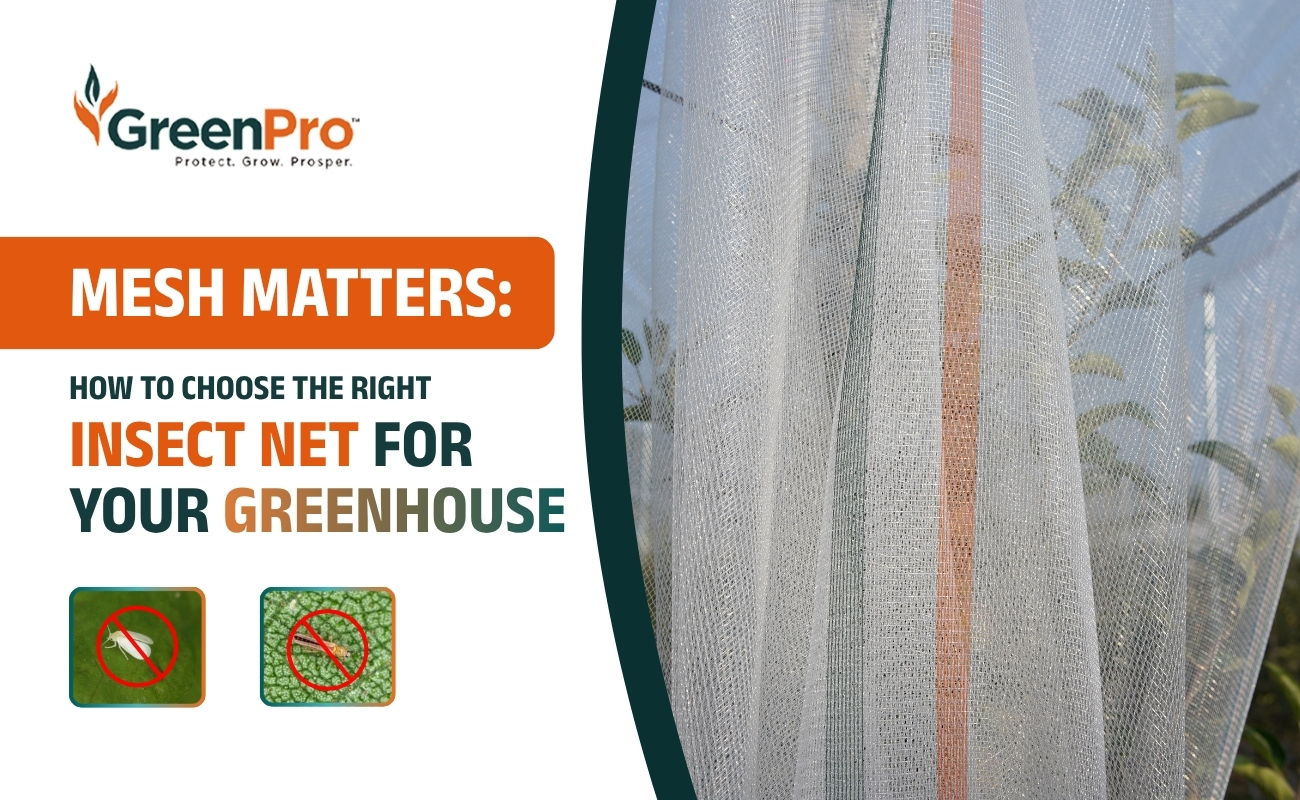
A good insect net may look like a small part of a polyhouse, but it can make a major difference in crop protection. Tiny insects can enter through side vents, roof openings, and doors, multiply rapidly, and damage the crop before the infestation becomes clearly visible.
Whiteflies, thrips, aphids and leaf miners not only feed on plants but can also spread serious viral diseases. Once a viral disease enters a protected structure, pesticide sprays cannot cure infected plants. Preventing insects from entering is therefore more effective than controlling them after infestation.
This guide explains how an insect net protects crops, why Pest Control Mesh count matters, and how growers can select the right net for their polyhouse, nursery or insect net house.
How Insects Damage Greenhouse Crops
Small insects can cause both direct and indirect crop damage.
Whiteflies, aphids and thrips suck plant sap, weakening the crop and slowing plant development. Thrips can damage flowers and developing fruits, while leaf miners create tunnels inside leaves and reduce photosynthesis.
Several insects also act as carriers of plant viruses: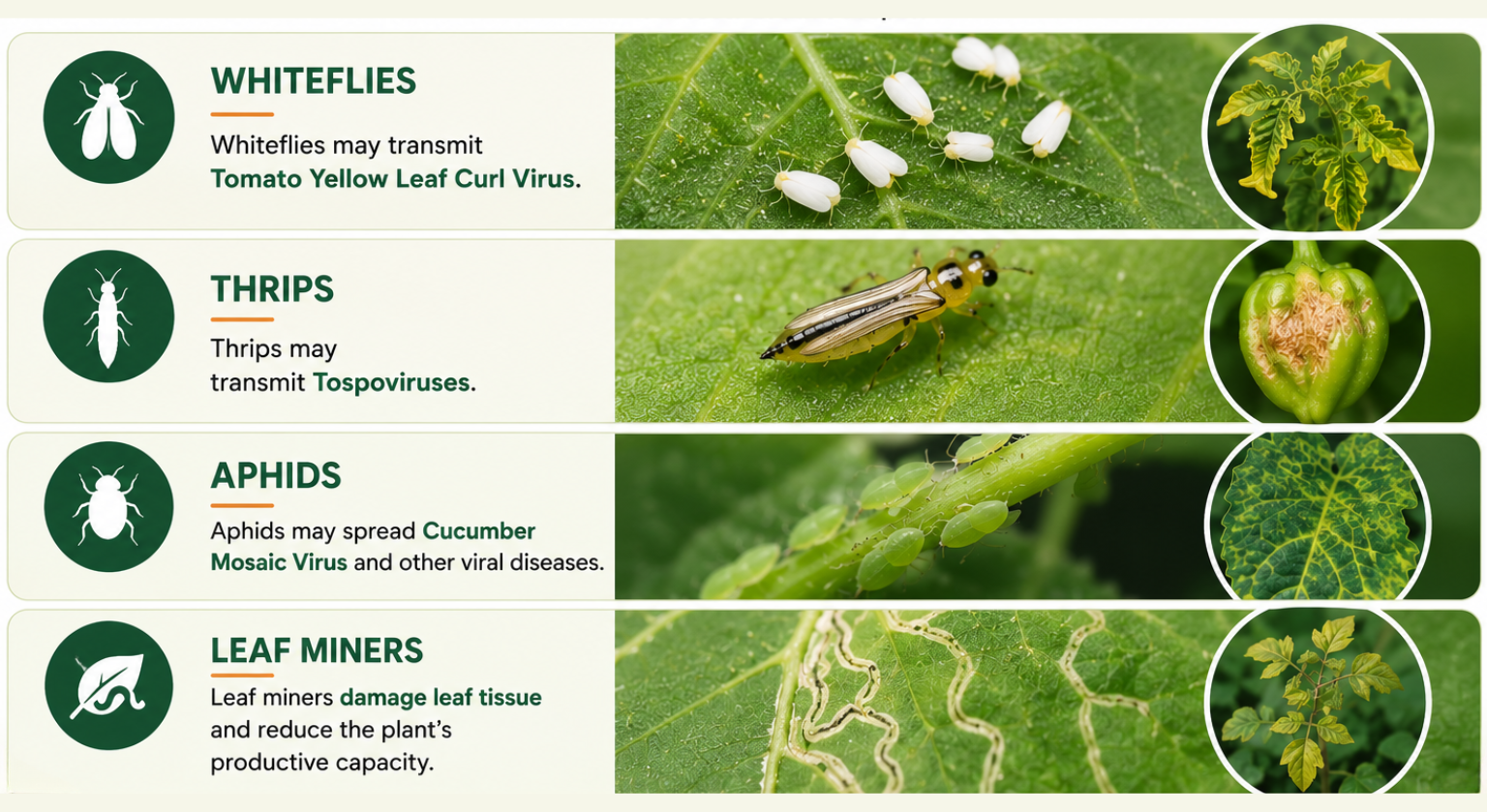
Repeated pesticide applications may kill some insects already present inside the structure, but they cannot prevent new insects from entering. Excessive spraying also increases cultivation costs, may leave unwanted residues and can contribute to insecticide resistance.
An insect net helps break this cycle by creating the first physical line of defence around the crop.
How Does an Insect Net Protect Crops?
An insect net reduces the entry of targeted insects before they reach the plants.
In a polyhouse, insect nets are generally installed over:
- Side ventilation openings
- Roof and gable vents
- Doors and entry points
- Cooling-pad and exhaust-fan openings
- Other exposed areas of the structure
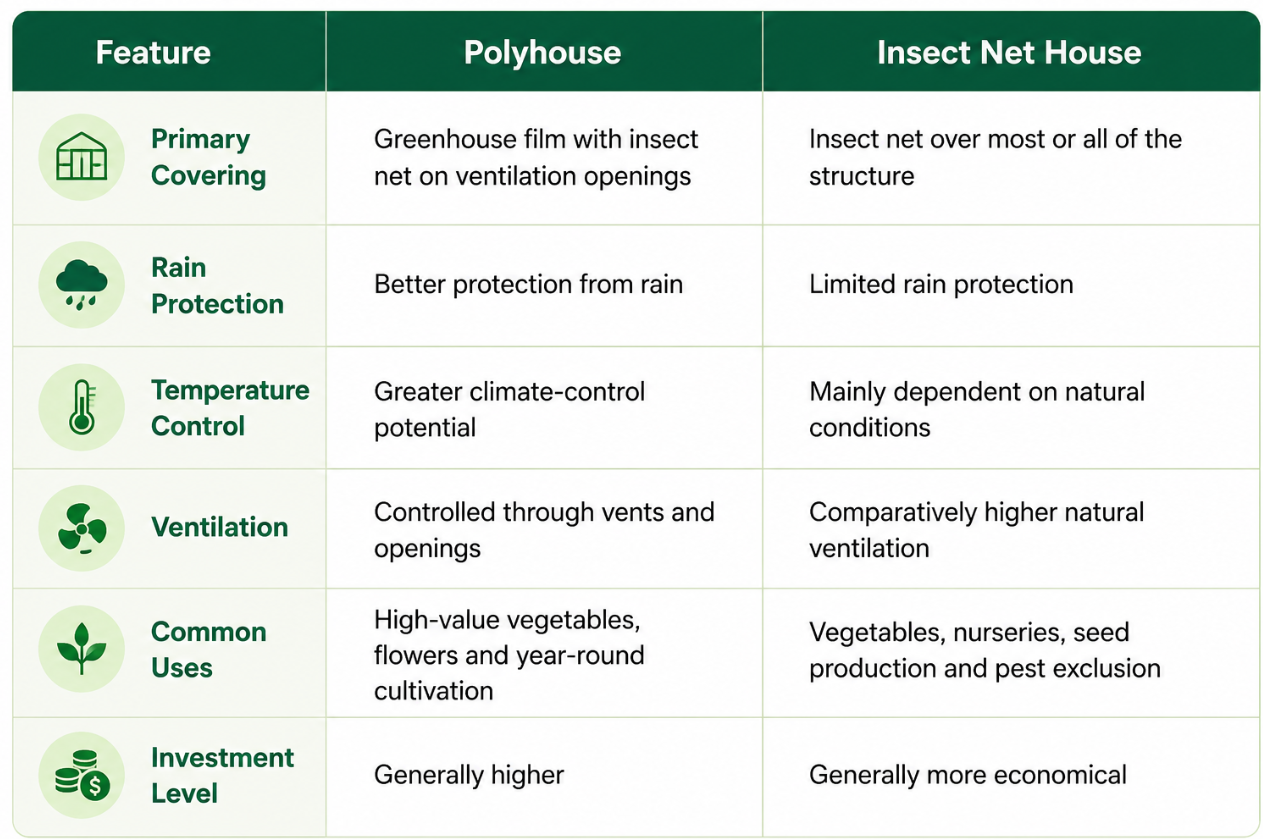
Greenhouse film protects crops from rain and helps manage the internal climate, while insect netting protects open ventilation areas from pest entry.
In an insect net house, the net forms the primary covering around the crop. Such structures are commonly used for vegetable cultivation, commercial nurseries, seed production, mother plant protection and plant-hardening units.
Major Benefits of Using an Insect Net
- Pest Exclusion: The net acts as a physical barrier and helps reduce the entry of whiteflies, aphids, thrips, leaf miners and other harmful insects.
- Lower Risk of Viral Diseases: By limiting the entry of insect vectors, a well-selected net can help reduce the risk of insect-transmitted crop diseases.
- Reduced Chemical Dependency: Lower pest pressure may reduce the frequency of pesticide applications when insect netting is combined with proper crop monitoring and Integrated Pest Management.
- Protection for Young Plants: Seedlings and young plants are highly sensitive to insect attack and repeated chemical exposure. Insect nets provide preventive protection during their most vulnerable growth stages.
- Controlled Ventilation: A properly selected insect net allows air movement through the structure. However, ventilation depends on mesh count, opening size, yarn thickness, net cleanliness, and total ventilation area.
- Partial Wind Protection: Insect netting can reduce the direct force of wind and limit the entry of wind-blown dust and debris. However, it should not be treated as complete protection against storms or extreme winds.
- Limited Shade Effect: Depending on yarn density and construction, an insect net may provide limited shade and light diffusion. However, it is not a replacement for a dedicated shade net where a specific shade percentage is required.
Why Does Pest Control Mesh Count Matter?
Mesh count indicates the fineness of an insect net. A higher Pest Control Mesh count generally means smaller openings, while a lower mesh count provides larger openings.
The selection creates an important balance between insect exclusion and ventilation.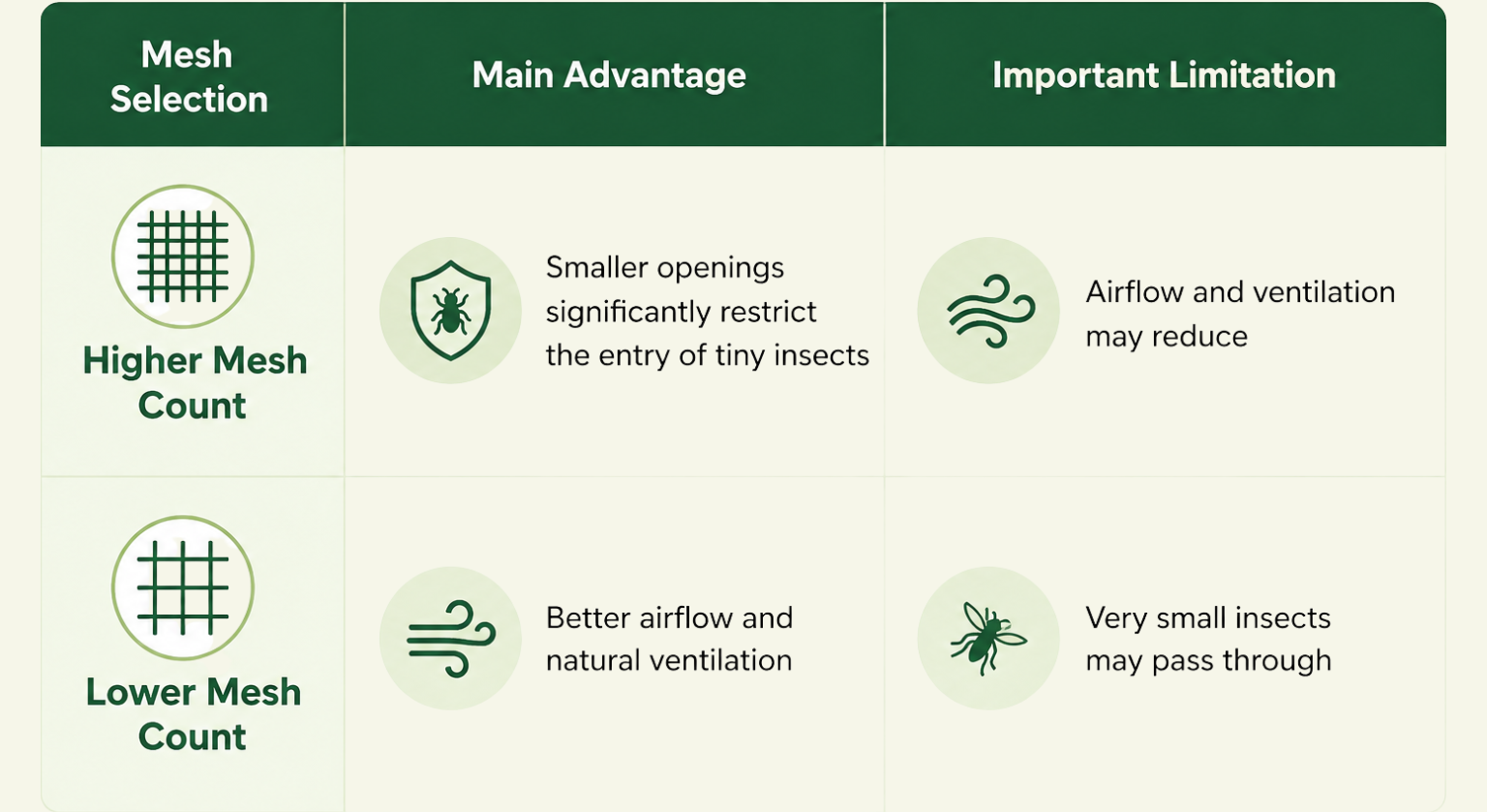 The highest mesh count is not automatically the best choice. An unnecessarily fine net can reduce airflow and increase heat or humidity inside the structure, particularly in hot and humid regions.
Growers should select the coarsest mesh that can effectively restrict the target pest while maintaining sufficient ventilation for the crop.
Mesh Count and GSM Are Different
Mesh count and GSM represent two different characteristics of an insect net.
- Mesh count refers to the number of openings or threads per unit area and indicates the fineness of the net. It helps determine which insects the net may restrict.
- GSM means grams per square metre and indicates the weight of the material. It helps assess the net’s strength, density and suitability for different structures.
A higher GSM does not automatically mean better protection from smaller insects. Similarly, a higher mesh count does not always mean a stronger net. Growers should consider Pest Control Mesh count, actual aperture size, GSM, yarn quality and UV stabilisation together.
Polyhouse vs Insect Net House
Both structures use insect netting, but their purpose and level of environmental control are different. The correct structure should be selected based on crop value, season, rainfall, temperature, pest pressure, and the level of environmental control required.
 What an Insect Net Cannot Do?
An insect net is a preventive pest-exclusion tool, but it cannot solve every crop-protection problem.
It cannot:
- Cure plants already infected by viruses
- Remove insects already present inside the structure
- Replace regular crop scouting and sanitation
- Provide complete protection from rain, hail or strong storms
- Replace a shade net where a specific shade percentage is required
- Guarantee complete insect exclusion if doors, joints or edges have gaps
Before installing or closing the structure, growers should remove infected plants, control weeds, inspect planting material and ensure that the inside area is as pest-free as possible.
Use Insect Nets as Part of Integrated Pest Management
An insect net provides the best results when used as part of an Integrated Pest Management programme.
It should be combined with:
- Pest-free seedlings and planting material
- Yellow sticky traps for whiteflies and aphids
- Blue sticky traps for thrips
- Regular crop scouting
- Removal of infected plants
- Weed control inside and around the structure
- Double-door entry systems
- Cleaning of tools and equipment
- Biological control wherever suitable
- Need-based and responsible pesticide application
Sticky traps should be used for monitoring and reducing insect pressure, but they do not replace proper insect netting.
Final Checklist Before Buying an Insect Net
Before placing an order, growers should check:
- Which pest needs to be controlled?
- What is the insect’s approximate body width?
- What is the actual aperture size of the net?
- Is the mesh suitable for the local climate?
- Will the structure provide adequate ventilation?
- Is the material UV-stabilised?
- Is it made from strong and uniform-quality yarn?
- Is the net suitable for the local wind conditions?
- Does the crop require natural or managed pollination?
- Are the correct width and roll length available?
- Can the doors, joints and edges be sealed properly?
- What installation, maintenance and warranty conditions apply?
Growers should request a technical specification sheet or sample before purchasing netting for a large commercial structure.
Insect Size vs Mesh Size
Insect size is one of the most important factors in mesh selection. However, the insect’s body width is generally more important than its total length.
A long but narrow insect may pass through an opening that blocks a shorter but wider insect. Thrips are especially difficult to exclude because of their narrow bodies.
The following approximate measurements help explain why different pests may require different mesh openings: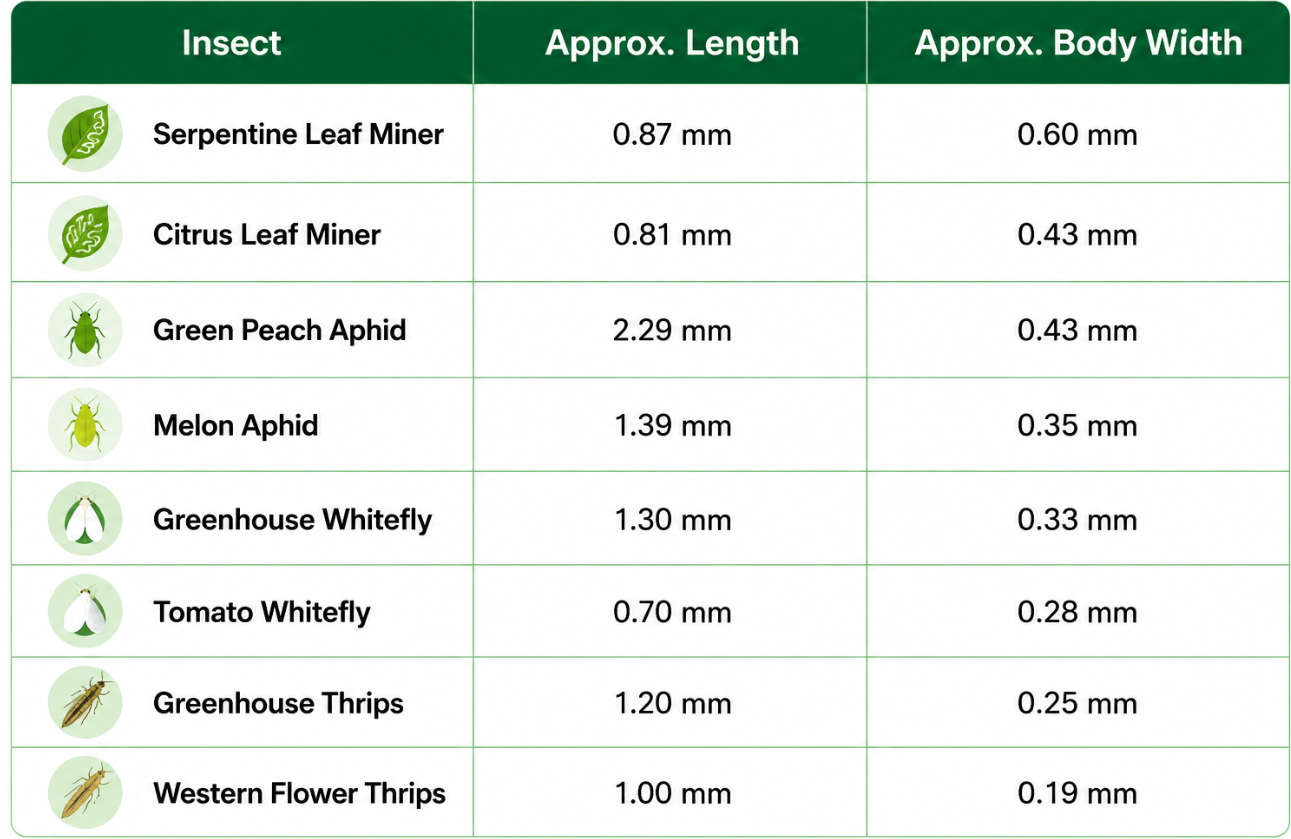 These dimensions are approximate and may vary according to the insect’s species, sex and growth stage.
The table shows why thrips can be more difficult to exclude than aphids or whiteflies. Although thrips may be similar in length, their bodies are much narrower.
Mesh Count Alone Is Not Enough
Two insect nets with the same mesh count may not provide identical protection. Actual performance is also affected by:
- Yarn thickness
- Weaving pattern
- Uniformity of openings
- Actual aperture size
- Net tension during installation
- Quality of joints and sealing
This is why farmers should not select insect netting only by looking at the mesh number. The net’s actual aperture and technical specifications should also be checked. A net may have the correct mesh count, but if the openings are uneven or the installation leaves gaps, small pests can still enter.
Which Crop Needs Which Mesh?
Different crops attract different pests. The following table can be used as a general starting reference: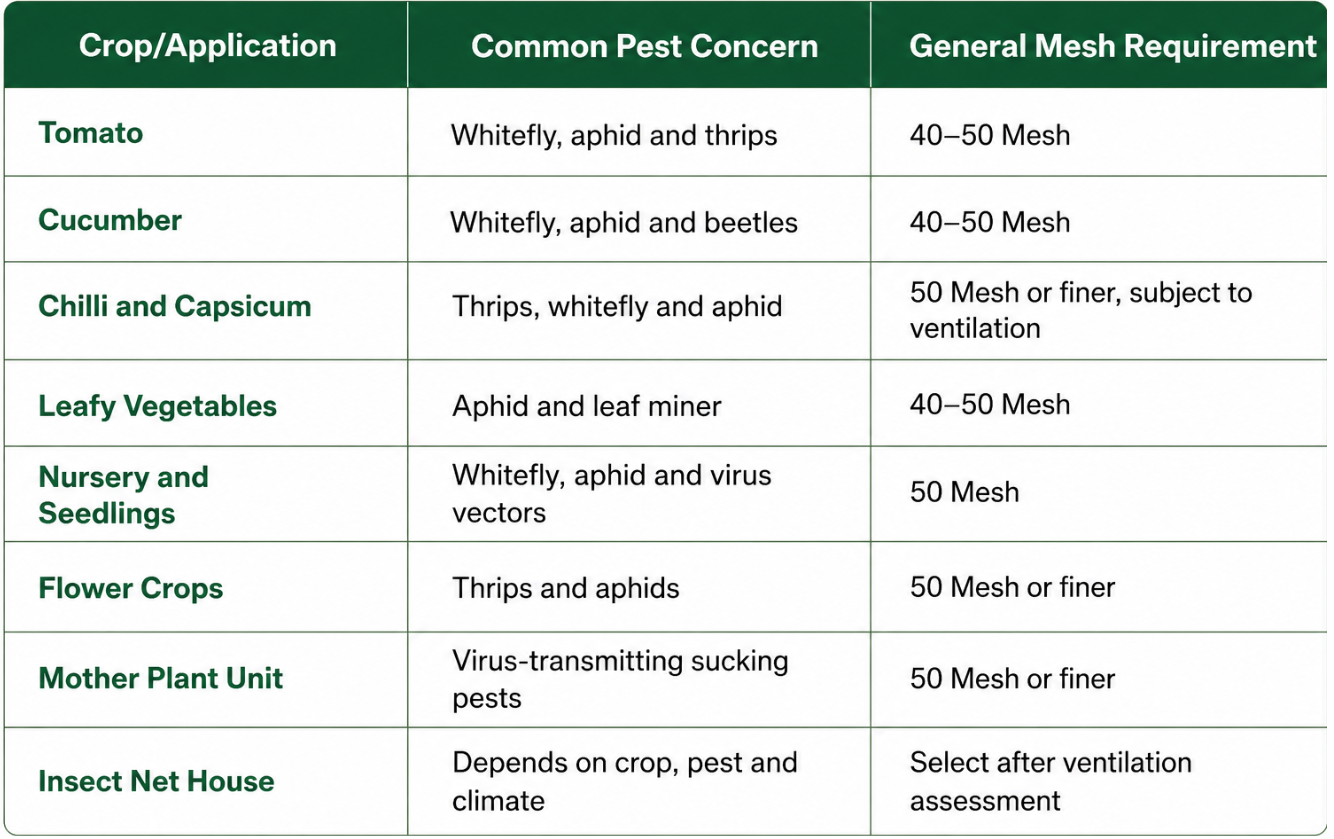 These are general starting recommendations. Final selection should depend on local pest pressure, the crop, climate, structure design, and the net’s actual aperture size.
Where very small pests such as Western Flower Thrips are the main concern, the suitability of the mesh should be confirmed using the actual opening size rather than mesh count alone.
Applications of Insect Nets
- Polyhouses: Insect nets are installed on sidewalls, vents, doors and other openings. They protect the structure from pest entry while maintaining the ventilation required for crop growth.
- Insect Net Houses: In an insect net house, netting forms the main protective covering. These structures generally provide better natural ventilation than fully film-covered polyhouses but may not offer the same protection from rain or temperature fluctuations.
- Nurseries: Insect nets help protect young seedlings, grafted plants, and planting material from sucking pests and viral diseases.
- Seed-Production Units: They help reduce unwanted insect movement and provide better control over the seed-production environment.
- Mother Plant and Hardening Units: Insect netting provides additional protection to valuable mother plants, tissue-culture plants, and newly hardened seedlings.
Important Points Before Selecting an Insect Net
- Identify the Target Pest: Start with the insect causing the greatest damage. Net selection should be based on the target pest rather than price alone.
- Check the Actual Aperture: Ask for the actual opening size along with the mesh count. This is especially important when protection from small insects such as thrips is required.
- Select Quality Material: UV-stabilised HDPE monofilament netting is suitable for prolonged outdoor exposure. Yarn strength, weaving uniformity and UV stabilisation influence durability and performance.
- Consider Local Climate: In hot and humid regions, excessively fine mesh may reduce ventilation and increase internal temperature and humidity.
- Maintain Adequate Ventilation: As the mesh becomes finer, airflow resistance increases. The structure may therefore require a larger total ventilation area.
- Seal Every Opening: Even a small gap around a door, joint, foundation, or ventilation opening can allow insects to enter. All edges and connections should be properly secured.
- Install a Double-Door Entry: A double-door entry chamber can reduce the possibility of insects entering with workers, tools or planting materials.
- Check Pollination Requirements: Fine insect nets may restrict natural pollinators such as bees. Crops requiring insect pollination may therefore need managed pollination.
Installation and Maintenance Tips
Even a high-quality insect net will not perform properly if it is poorly installed or damaged.
Growers should:
- Keep the net properly stretched and secured
- Seal gaps around doors and structural joints
- Repair cuts and tears immediately
- Check clips, fasteners, and stitching regularly
- Remove dust accumulation to maintain airflow
- Inspect the net before every planting cycle
- Control weeds inside and around the structure
- Use sticky traps to monitor insects inside the structure
An insect net works best when combined with crop scouting, sanitation, healthy planting material, sticky traps and need-based pest management.
Choose the Right Mesh for Better Crop Protection
A polyhouse is only as protected as its weakest opening. The right insect net can help reduce pest entry, lower viral disease risk and support healthier crop development from seedling to harvest.
The best insect net is not simply the net with the highest mesh count. It is the one that creates the correct balance between insect exclusion, ventilation, strength, crop requirements and local climate.
GreenPro Ventures provides UV-stabilised insect net solutions designed for polyhouses, insect net houses, nurseries and other protected cultivation applications. Selecting the right mesh and installing it correctly can help protect crops before pest problems begin.
Choose GreenPro for Reliable Crop Protection
GreenPro Ventures manufactures high-quality, UV-stabilised insect nets for polyhouses, insect net houses, nurseries and other protected cultivation applications. With customisation available from 25 Mesh to 80 Mesh, growers can select the right solution according to their crop, target pest, climate and ventilation requirements.
GreenPro’s protected farming solutions are exported to 42+ countries and are trusted by more than 1 lakh farmers and growers worldwide. Backed by advanced manufacturing, consistent mesh openings and stringent quality control, GreenPro Insect Nets provide dependable protection for modern cultivation.
Choose GreenPro Insect Nets—customised protection designed for your crop and climate.
FAQ
There is no single mesh suitable for every crop. The correct mesh depends on the target insect, actual opening size, crop and ventilation requirement.
No. A higher mesh count provides smaller openings but may also reduce ventilation. The mesh should restrict the target pest without unnecessarily reducing airflow.
An insect passes through a net according to the narrowest part of its body. Therefore, body width is generally more important than total body length when selecting a mesh.
Yes. They can be installed on sidewalls, roof vents, doors, cooling-pad openings and other ventilation areas.
Yes. In an insect net house, the net forms the main covering and provides pest exclusion with natural ventilation.
Yes. All netting creates some resistance to airflow. A finer mesh generally reduces airflow more than a coarser mesh.
It may provide limited shade depending on its construction, but it cannot replace a dedicated shade net when a specific shade percentage is required.
No insect-exclusion system should be treated as 100% effective. Performance depends on the aperture size, installation, sealing, pest pressure and regular maintenance.
Regularly check for tears, loose edges, damaged joints and dust accumulation. Repair damaged areas immediately and keep the net clean to maintain airflow.