How HDPE Pond Liners Help Save Water and Increase Farm Profitability
In many villages, farmers invest time and money to build a pond, hoping it will secure water for the entire season. But within a few weeks, the water level starts dropping. The soil absorbs it. Cracks appear. What was meant to be a solution slowly becomes a problem. This is where an HDPE pond liner changes everything.
Water is the backbone of farming. When it is lost, crops suffer, electricity costs increase, and income decreases. Farmers across India are now turning toward smarter solutions to protect every drop. One of the most effective solutions is to use an HDPE pond liner, which ensures that stored water remains available when it is needed most.
What Is an HDPE Pond Liner?
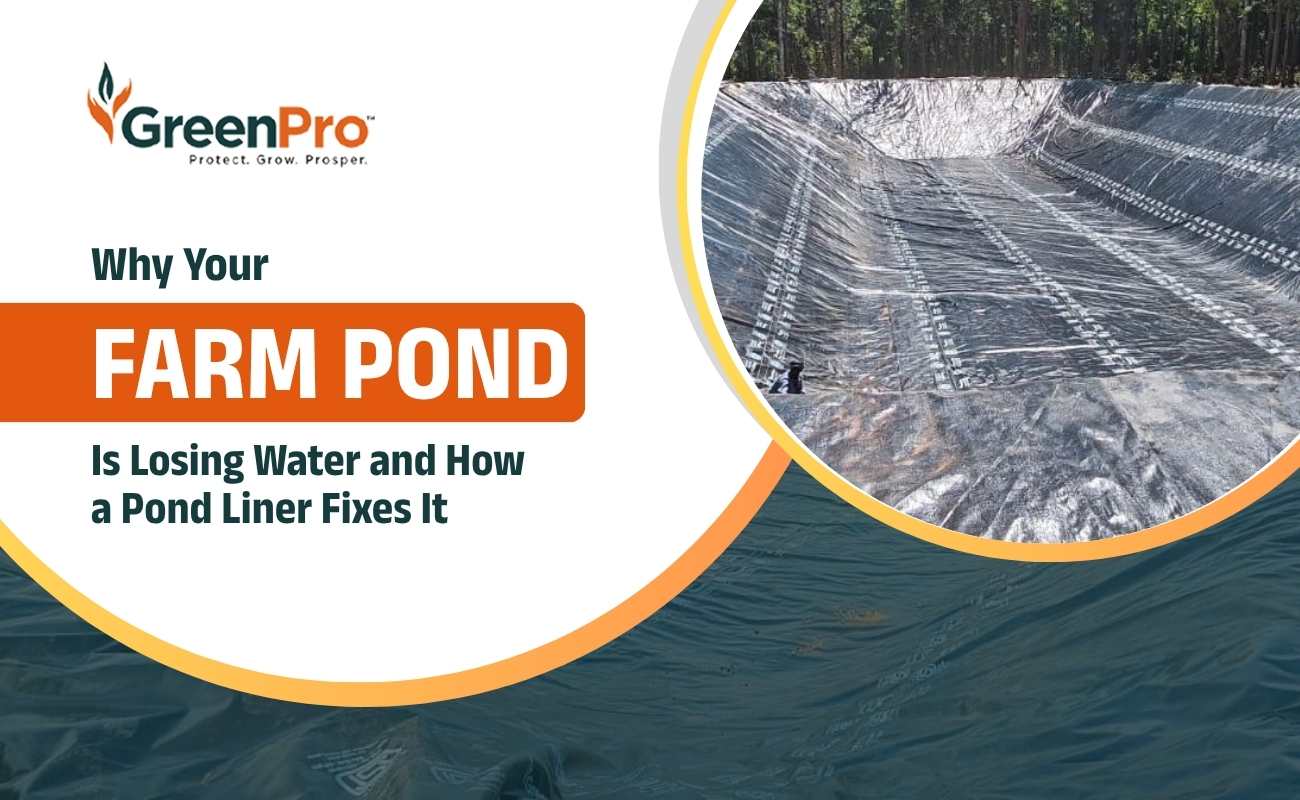
HDPE stands for High-Density Polyethylene. An HDPE pond liner is a thick, flexible sheet of engineered plastic that is laid across the bed and walls of a farm pond. It acts like a waterproof blanket between stored water and the soil beneath. Unlike clay or compacted earth, HDPE does not crack, shrink, or become porous over time.
Modern farm pond liners use advanced multi-layer technology. The layers work together to resist punctures, handle ground movement, and block ultraviolet radiation from the sun. The result is a pond that reliably holds water, season after season, with almost no loss to the ground.
Why Traditional Farm Ponds Lose So Much Water
The problem begins with soil. Most agricultural land contains sand, silt, or naturally fractured clay. Water does not stay in place on such surfaces. It seeps through microscopic gaps and travels downward into the water table, far below where roots can reach.
Poor pond construction makes things worse. When ponds are dug quickly without proper lining or compaction, the bed and side walls allow water to escape from multiple directions at once. Seasonal cracking in dry months opens new channels for seepage. By the time a farmer needs water most, the pond is at a fraction of its original capacity.
Add evaporation losses from open water surfaces in hot climates, and the combined effect can drain 30 to 60 percent of stored water before the dry season even peaks.
How a Pond Liner Prevents Water Loss
A well-installed HDPE pond liner creates a completely impermeable barrier. Water cannot pass through it. What you store in November is still there in April. This simple fact transforms how a farmer plans irrigation.
With a lined pond, irrigation schedules become predictable. Crop watering is no longer rationed out of anxiety. Farmers can plan second and third crops in a season because they know their water supply will last. During a drought, a lined pond becomes the most valuable asset on the farm.
For aquaculture operators, the benefits are even more direct. Fish pond liners eliminate soil contamination of the water, reduce ammonia buildup from soil interaction, and make pond cleaning far more efficient. Fish survival rates improve when water quality stays consistent.
Where Pond Liners Are Being Used
The applications go well beyond the individual farm. Irrigation project planners are lining entire canal networks to reduce transmission losses. Community water storage tanks in rain-fed areas use liners to make harvested rainwater last through dry months. Reservoir operators in semi-arid regions use liners to extend the usable life of infrastructure that would otherwise need costly repairs every few years.
In aquaculture, fish and shrimp farmers from Andhra Pradesh to Bangladesh have adopted fish pond liners to boost productivity, reduce disease, and lower the frequency of pond turnover. On farms, a simple farm pond liner brings the same technology that large irrigation bodies use down to the scale of a single family holding.
Benefits That Reach the Bottom Line
What to Look for in a Quality Pond Liner
Not all pond liners perform equally. When selecting a liner for a farm pond or aquaculture application, consider the following factors.
Material quality is the foundation. HDPE is the most widely trusted material because it resists chemical exposure, does not degrade when in contact with soil, and remains flexible across temperature extremes. Thickness matters too: ponds with uneven terrain or rocky beds need thicker sheets, typically 0.5mm to 1mm or above, depending on the load and use case.
UV resistance is essential for ponds with exposed edges or shallow water. A liner that cannot resist prolonged sunlight will degrade and crack within a few years. Flexibility ensures the liner conforms to the pond shape during installation without tearing at corners.
GreenPro Ventures manufactures HDPE pond liners that meet these technical demands. As established pond liner manufacturers with field-tested products, they design their liners for both small farm applications and large irrigation infrastructure, with options suited to aquaculture, rainwater harvesting, and canal lining.
Pond Liners and the Future of Sustainable Farming
Water scarcity is no longer a future concern. It is a present reality for a growing number of farming communities. Climate variability has made rainfall unpredictable. Groundwater levels are falling in regions that once felt water-secure. In this environment, every drop stored must be treated as an investment.
Pond liners are not just a product. They are committed to farming smarter. They enable farmers to shift from a survival mindset, rationing water in fear, to a planning mindset, knowing exactly how much water is available and building a crop calendar around it. That shift, modest as it sounds, is the foundation of farm profitability.
Ready to stop losing water and start growing more? Explore durable, high-performance HDPE pond liner solutions from GreenPro Ventures, trusted by successful farmers and aquaculture operators across the region.
FAQ
Q1. How long does an HDPE pond liner last on a farm?
A premium-quality HDPE pond liner can last 20 years or more when installed correctly. High UV resistance, selecting the proper material thickness, and ensuring secure anchoring at the pond edges are the primary factors that determine its ultimate lifespan.
Q2. Can pond liners be used for fish and shrimp farming?
Yes, absolutely. Fish pond liners are widely used in commercial aquaculture because they completely prevent the soil contamination of water, drastically reduce harmful ammonia interactions, and make routine pond cleaning significantly easier. They directly improve overall water quality and boost fish survival rates.
Q3. What thickness of HDPE pond liner should I choose for my farm pond?
The correct thickness depends entirely on the pond’s size, the underlying soil condition, and the intended daily use. For small to medium-sized farm ponds, a thickness of 0.5mm to 0.75mm is standard. Larger commercial sites or ponds with rocky beds may require 1mm or above. Experts at GreenPro Ventures can advise you on the exact specification needed for your specific application
Q4. Is it difficult to install a farm pond liner?
Installation is relatively straightforward for most standard pond sizes. The liner is simply unrolled, carefully positioned to fit the contours, and securely anchored in trenches at the top edges. Many farmers easily complete smaller installations using local agricultural labor. However, larger commercial projects benefit greatly from professional installation support provided directly by the manufacturers.
Q5. How much water can a pond liner actually save?
Extensive agricultural studies and field data consistently show that unlined ponds in porous soils lose between 30 to 60 percent of their stored water simply through ground seepage. A properly installed HDPE pond liner reduces this seepage loss to near zero, effectively doubling or even tripling the actual usable water available to a farmer throughout a long dry season.