
Smart Protection: Choosing Between Black and White Hail Nets for Your Farm
As a farmer, you know that a sudden hailstorm is a nightmare. In just ten minutes, the hard work of an entire year, whether it’s your Apple orchard in Himachal or your Pomegranate farm in Karnataka, can be destroyed. But today, the challenge isn’t just the hail falling from the sky. It is also the intense Indian sun. Rising temperatures, fruit sunburn (sunscald), and heat stress are making it harder to grow high-quality produce. This is why choosing the right hail nets is no longer just about stopping stones; it is about managing light.
Most farmers ask: “Should I choose a Black net or a White net?” Both have different roles in how your plants “cook” their food. Let’s look at the science of light to help you make the right business choice.
Understanding the “Kitchen” of Your Plant
Think of your plant as a factory. The leaves are the “kitchen” where food is made through Photosynthesis.
- The Recipe: Leaves take sunlight, water, and air to create energy for the fruit.
- The Problem: If the “kitchen” gets too little light, the fruit stays small. But if it gets too much heat, the kitchen “catches fire.” The plant gets stressed, stops growing, and the fruit gets burnt.
In India, especially during April and May, our plants often spend more energy trying to stay cool than they do making fruit sweet. The color of your net, whether Black or White, decides how much heat and light your “kitchen” receives.
White (Pearl) Hail Nets: The Light Diffusers
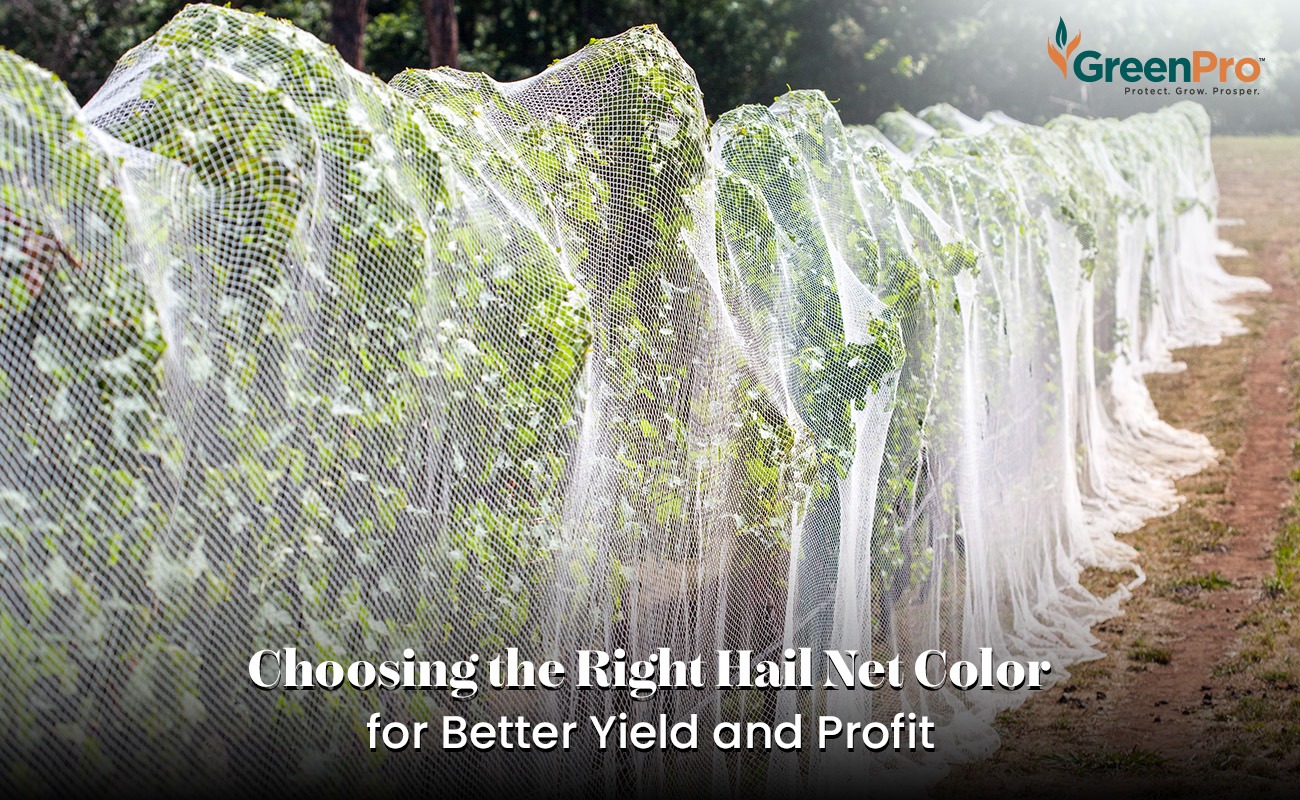
White hail nets are highly popular among Apple, Citrus, and Litchi growers. They are designed to manage light rather than just block it.
How they work: White hail nets act like a filter that scatters sunlight. Instead of the sun hitting only the top leaves (which can cause sunburn), the net spreads the light evenly. This allows soft, “diffused” light to reach the inner branches and the bottom of the tree.
Benefits for Indian Farmers:
- Uniform Coloring: Because light reaches everywhere, your Apples or Citrus fruits get a more even color and size.
- Lower Temperature: They reduce the direct “hit” of the sun, lowering the temperature of the fruit skin.
- Inner Growth: Better light reaching the center of the tree keeps the inner branches strong and productive.
Black Hail Nets: The Strong Shaders
Black hail nets are the traditional choice for regions with extreme heat, such as the plains of Maharashtra, Rajasthan, or Gujarat.
How they work: Black hail nets are “absorbers.” They block a significant percentage of sunlight and reduce brightness. They provide the most intense shade among all net types.
Benefits for Indian Farmers:
- Maximum Heat Protection: If your region faces 40°C+ temperatures regularly, black nets provide the strongest cooling effect.
- Reduced Water Stress: Because the shade is heavy, the soil stays moist for longer, and the plants lose less water through their leaves.
- Durability: Generally, black pigments handle UV radiation slightly better over very long periods.
A Word of Caution: Too much shade can be a problem. If a black net is too dense, it can slow down fruit ripening and reduce the sugar levels (Brix) in crops like Grapes.
Real-Life Usage in India
- High-Altitude Orchards (HP/Kashmir): Here, the sun is strong but the growing season is short. White/Pearl nets are usually best because they protect from hail while ensuring the fruit gets enough “scattered” light to develop that deep red color.
- Dryland Orchards (Maharashtra/Karnataka): For Pomegranates and Grapes, Black or dark-colored nets are often used to fight intense sunscald. However, many progressive farmers are now moving toward specialized White nets to improve fruit shine and export quality.
Common Mistakes to Avoid
- Wrong Selection for the Region: Putting a heavy black net in a cloudy area will lead to “pale” fruit. Putting a very thin white net in a desert-like heat may not stop sunburn.
- Poor Tension: If the net isn’t installed tight, it will sag under the weight of the hail, potentially snapping the branches of your trees.
- Quality Shortcuts: Cheap nets without proper UV stabilization will become brittle and “dusty” under the Indian sun within two years
How to Choose the Right Colored Hail Net?
Before you buy, consider these three factors:
- Your Crop: Does it need “red color” (like Apples) or just “shade” (like Nursery plants)?
- Your Climate: Is your biggest problem hail, or is it 45°C heat?
- Your Tree Density: Are your trees packed closely together? If yes, a White net will help light reach the bottom branches.
Smart Protection for Long-Term Income
Investing in a GreenPro Ventures Hail Net is not an expense, it is an insurance policy. Whether you choose the light-diffusing power of White or the cooling shade of Black, you are protecting your Mandi rate. A blemish-free, well-colored fruit will always fetch a premium price.
Protect your hard work today so you can harvest the rewards for years to come.
FAQ
Both Black and White GreenPro nets are UV-stabilized for the Indian climate. While black traditionally lasts slightly longer, our high-quality White/Pearl nets are engineered to last 5–10 years with ease.
If the shade is too heavy (above 50%), the fruit may not develop enough sugar. It is important to choose the right “shade percentage” based on your specific crop.
No. The mesh size is designed to allow bees to move in and out. Most farmers find that pollination continues normally under both black and white nets.
Installation requires a strong structure of poles and wires. We recommend professional supervision to ensure the tension is correct so the net can handle heavy hail loads.
While Black provides great shade, many farmers prefer White or Pearl because it prevents sunscald while still allowing the fruit to develop a healthy, bright skin color.