
Preventing Fungal Spots on Capsicum by Managing Greenhouse Condensation
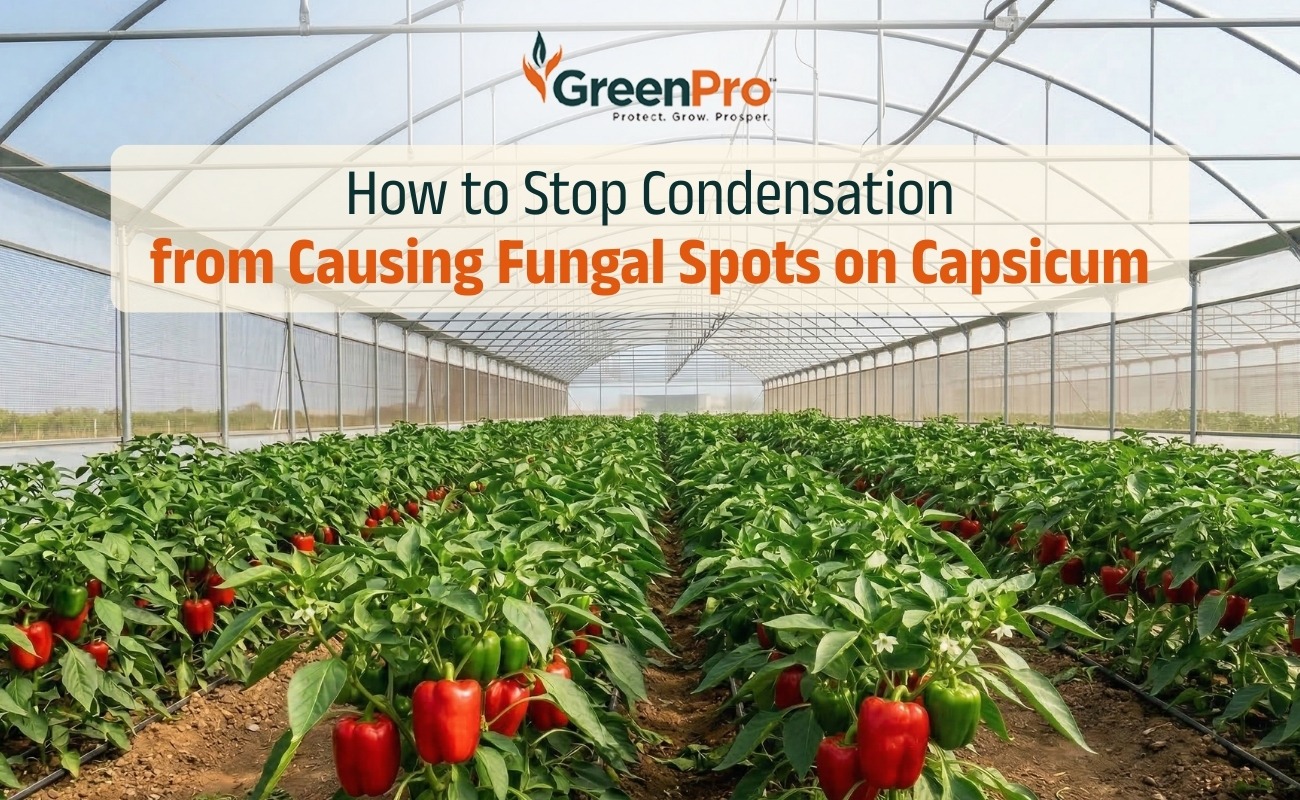
Greenhouse farming has made year-round capsicum cultivation possible throughout India. Farmers in Karnataka, Pune, Himachal Pradesh, and Rajasthan now grow premium capsicum in controlled environments, yielding higher prices. But this same controlled environment carries a hidden threat that can erase an entire season’s profit in a matter of weeks.
That threat is condensation. When moisture accumulates on plant leaves, fruits, greenhouse walls, and the underside of the film cover, fungal spores find everything they need to germinate and spread. Leaf spots, fruit blemishes, and grey mould destroy both crop quality and market value long before the farmer realizes the damage has begun.
 Understanding how condensation forms and how to eliminate it is one of the highest-value skills any capsicum grower can develop. This blog breaks down the causes, consequences, and complete prevention system in practical, actionable terms.
Why Capsicum Is Especially Vulnerable to Fungal Diseases
Capsicum plants are inherently sensitive to humidity. Their broad leaves, dense canopy, and clustered fruits create pockets where moisture lingers for hours. When relative humidity rises above 80 %, fungal pathogens activate and colonise rapidly.
Common fungal diseases in greenhouse farming include Cercospora and Alternaria leaf spots, fruit lesions that render produce unmarketable, powdery mildew that stunts growth, and Botrytis grey mould, which thrives in cool, humid winter conditions. All of these share a common trigger: prolonged wetness on plant surfaces due to condensation.
Early Warning Signs Every Farmer Must Watch For in Greenhouse Farming
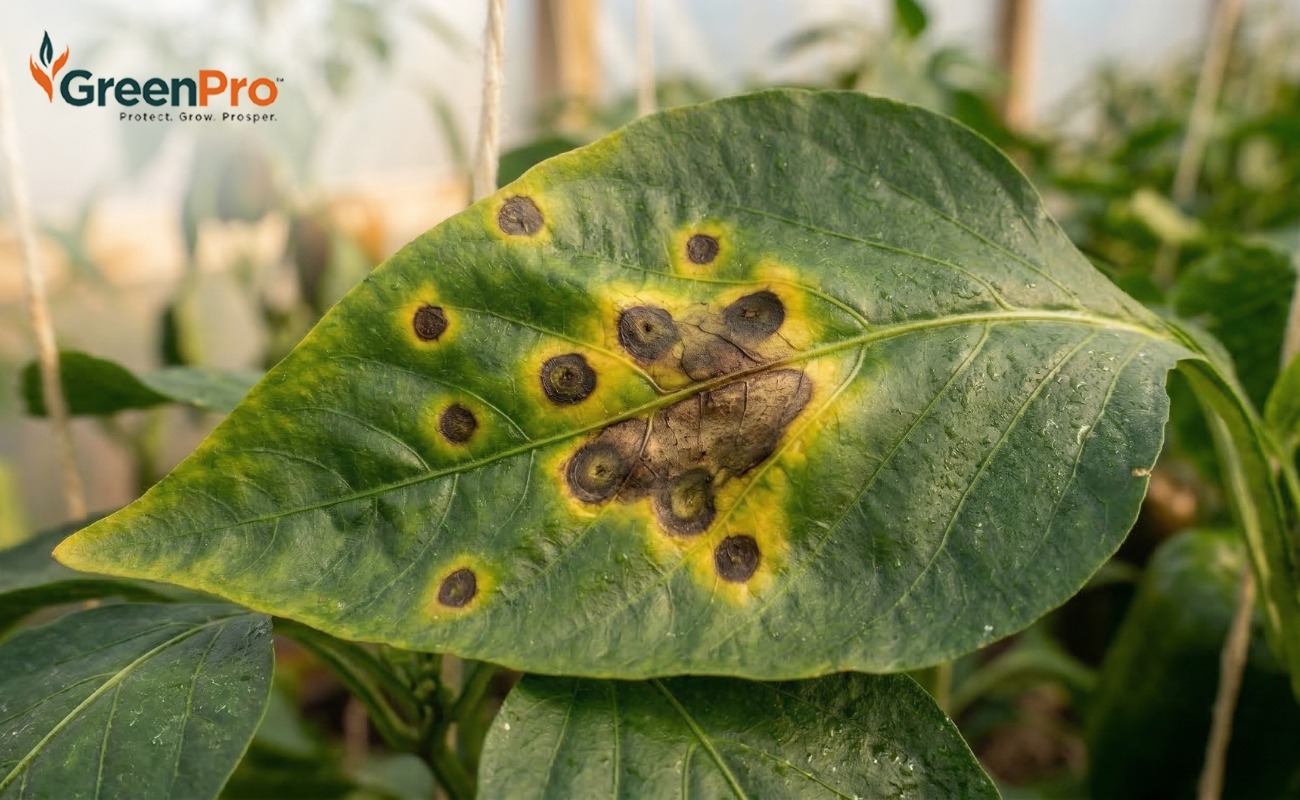
Fungal infections do not appear suddenly. They build from early symptoms that are easy to miss during a routine inspection. Knowing what to look for in the first 24 to 48 hours allows farmers to act before significant crop loss occurs.
- Small yellow or pale green patches appearing on older leaves in the lower canopy
- The underside of affected leaves becomes dull and slightly water-soaked in appearance
- White powdery coating begins on leaf edges before spreading to the upper surface
- Water-soaked circular spots appear on the fruit skin, initially transparent and then darkening
- Leaf edges curl slightly inward, and tips appear scorched without any heat or chemical cause
Any one of these signs observed during morning inspection should trigger immediate ventilation checks and humidity monitoring. Early intervention reduces treatment cost and prevents spread to healthy plants.
What Causes Condensation Inside a Greenhouse Farming
Condensation forms when warm, moisture-laden air inside the greenhouse comes into contact with a cooler surface. On cold January or monsoon mornings, the film ceiling cools overnight. When sunlight warms the interior air, the temperature gap triggers heavy condensation, and water droplets form and fall directly onto the crop below.
- Temperature differentials between inside and outside the greenhouse, especially during winter nights
- Poor ventilation that traps humid air near plant surfaces instead of exhausting it
- Evening irrigation that leaves the soil wet overnight and raises humidity to dangerous levels by morning
- Standard film without anti-drip technology that allows water to bead and drip onto plants
- Dense planting with no inter-row spacing that prevents air movement in the lower canopy
How Condensation Drives Financial Loss
A farmer walking into the greenhouse on a cold morning, seeing droplets running down the walls and coating the leaves, is seeing activated fungal spores being carried directly onto fruits and growing points. Water droplets transport infection from debris and soil to healthy plant tissue across the entire crop.
Fruit spots and lesions make capsicum unsellable in premium markets. Farmers in Delhi, Mumbai, and Bengaluru report significant revenue loss when fungal damage exceeds 20 % of the crop during the monsoon and winter seasons. Grade A capsicum sells for Rs 5 to Rs 10 more per kilogram than spotted or blemished fruit. When condensation is controlled, farmers consistently achieve cleaner fruits, uniform sizing, and Grade A prices that recover the full cost of their greenhouse investment.
Greenhouse Design That Controls Condensation
A well-designed greenhouse farming eliminates most condensation risk, so no practice-level intervention is required. Structure, orientation, and materials are the foundation of moisture management.
- Ridge Vents: Position ridge vents at the highest point of the structure. Hot, humid air rises and exits naturally. Keep ridge vents open from 10 AM to 4 PM during the winter and monsoon months to release accumulated humidity before evening temperatures drop, creating condensation.
- Side Ventilation Panels: Side vents draw in cooler, drier outside air at the plant level. This cross-ventilation pattern reduces overall internal humidity and breaks the stagnant air zones where moisture accumulates.
- Structural Pitch: A steeper roof pitch channels condensation water along the film surface toward side gutters rather than allowing it to drip onto the crop.
- Greenhouse Orientation: In India, a north-to-south axis maximises exposure to morning sunlight, warming the structure evenly and drying condensation quickly after sunrise.
Upgrade to Anti-Drip Greenhouse Film
Not all greenhouse film performs equally. Anti-drip additives cause condensation to sheet toward gutters rather than drip onto crops, eliminating the primary route for fungal spore transmission. Thermal IR retention reduces overnight condensation by maintaining internal temperatures. UV stabilisation preserves these properties across multiple seasons. Light diffusion technology dries leaf surfaces faster after morning condensation. Farmers switching to quality anti-drip film report fungal infection dropping by up to 70% in a single season — an investment that typically pays for itself within one to two crop cycles.
Anti-drip greenhouse film alone reduces 60 to 80 % of fungal spread caused by dripping condensation during winter mornings. This is the single highest-impact material upgrade available to capsicum growers.
Circulation Fans: The Missing Tool in Most Indian Greenhouses
Ventilation vents manage air at the structural level. Circulation fans manage air at the crop canopy level, where fungal infections begin.
Installing horizontal airflow fans inside the greenhouse improves internal air movement by 30 to 40 %. Fans dry leaf surfaces faster after morning condensation events, reduce the duration of leaf wetness, and break the stagnant air pockets in the lower canopy where humidity is highest.
For greenhouse structures longer than 30 metres, fans positioned every 15 to 20 metres along the length of the structure create a continuous air circulation loop that ventilation vents alone cannot achieve. For dealers and distributors, circulation fans represent a high-value addition to greenhouse infrastructure that is easy to demonstrate and generates strong repeat interest from growers who observe the results.
Capsicum Spacing Guide for Optimal Airflow
Plant spacing is one of the most overlooked contributors to fungal disease in greenhouse capsicum. Crowded plants restrict airflow within the canopy and extend leaf wetness duration after any condensation event.
| Spacing Type | Recommended Distance | Purpose |
| Plant to Plant | 40 to 45 cm | Allows air between individual plants |
| Row to Row | 60 to 75 cm | Enables airflow through the canopy |
| Walking Path Width | 90 to 120 cm | Access for inspection and operations |
Daily Monitoring Checklist for Capsicum Growers
Use this checklist every morning before 9 AM, particularly during the monsoon and winter months.
Best Practices That Deliver Results
- Irrigate in the morning, not the evening. Morning watering allows soil and plant surfaces to dry before nighttime temperature drops.
- Maintain relative humidity between 60 and 70 % using hygrometers positioned at canopy height.
- Remove plant debris, including dead leaves and fallen fruit, from the greenhouse at least twice per week.
- Apply copper-based or systemic fungicides preventively during the monsoon and early winter when humidity cannot be fully controlled by ventilation.
- Use thermal screens on cold nights to reduce the temperature differential between inside and outside the greenhouse.
Why Dealers and Distributors Should Actively Recommend Anti-Drip Film and Net
For dealers and distributors supplying greenhouse infrastructure, anti-drip film, and quality greenhouse net represent the highest-satisfaction products in the portfolio for one simple reason: farmers see measurable results within 10 to 15 days of installation.
- Zero complaint material. Anti-drip film performs visibly and immediately. Farmers observe the difference on the first morning after installation.
- Farmers who see a 60 to 70 % reduction in fungal incidence within one season become long-term customers who recommend the product within their networks.
- High repeat demand. Film replacement cycles and net upgrades create predictable seasonal reorder volumes.
- Better customer satisfaction from measurable crop outcomes leads to stronger dealer-farmer relationships and faster referrals to neighbouring farms.
- Circulation fans, anti-drip film, and quality greenhouse net sold together as a condensation control package create higher average order values and position the dealer as a solutions provider rather than a commodity supplier.
Control Condensation and Protect Your Profit
Ready to protect your capsicum crop? Partner with Greenpro Ventures for anti-drip films, quality nets, and expert guidance, and grow Grade A produce every season.
FAQ
Fungal spots are caused by condensation that forms when warm, humid indoor air meets cool greenhouse film or plant surfaces. The water droplets carry and spread fungal spores from soil debris and infected tissue to healthy leaves and fruits across the entire crop.
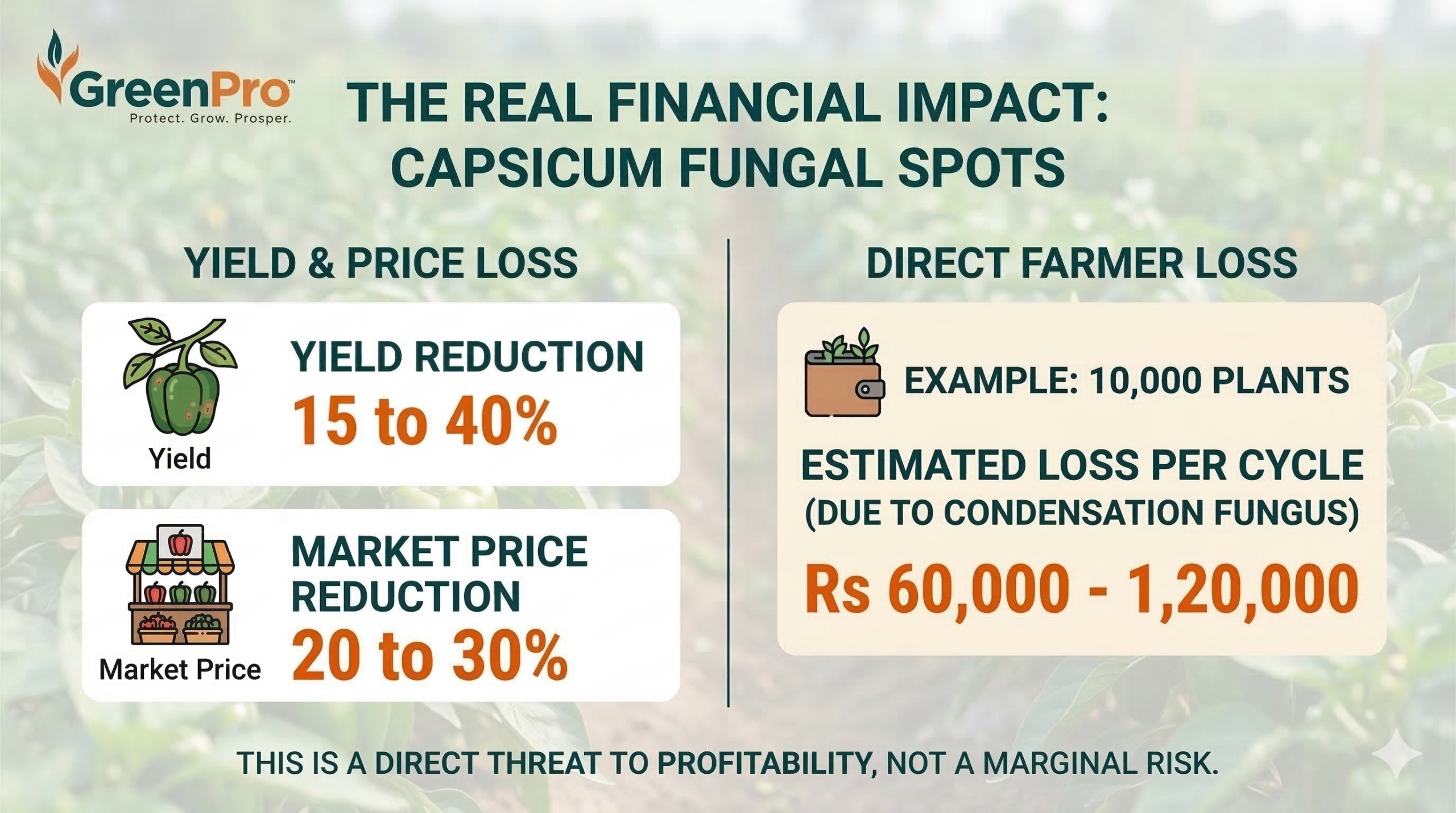
Fungal diseases reduce capsicum yield by 15 to 40 % and market price by 20 to 30 %. A farmer with 10,000 plants can lose between Rs 60,000 and Rs 1,20,000 per crop cycle. Grade A blemish-free capsicum consistently sells for Rs 5 to Rs 10 more per kilogram than fungal-damaged produce.
Anti-drip film contains additives that reduce the surface tension of condensation water. Instead of forming droplets that fall onto plants and spread spores, moisture flows as a thin sheet toward the side gutters. This eliminates the primary spread mechanism and reduces fungal infection by 60 to 80 % during winter mornings.
Ridge vents should remain open from 10 AM to 4 PM during winter and monsoon months. This window allows accumulated heat and moisture to exit before evening temperature drops create the condensation conditions that activate fungal spores overnight.
Recommended capsicum spacing for airflow and disease prevention is 40 to 45 cm between plants, 60 to 75 cm between rows, and 90 to 120 cm for walking paths. Correct spacing allows air to circulate through the lower canopy, reducing the duration of leaf wetness after condensation events.
Anti-drip film and quality greenhouse net sold together deliver visible results within 10 to 15 days, generating immediate farmer satisfaction and strong repeat demand. Farmers who observe a 60 to 70 % reduction in fungal incidence in their first season become long-term customers who actively recommend the product to neighbouring growers.